

What Are E-Tabs?
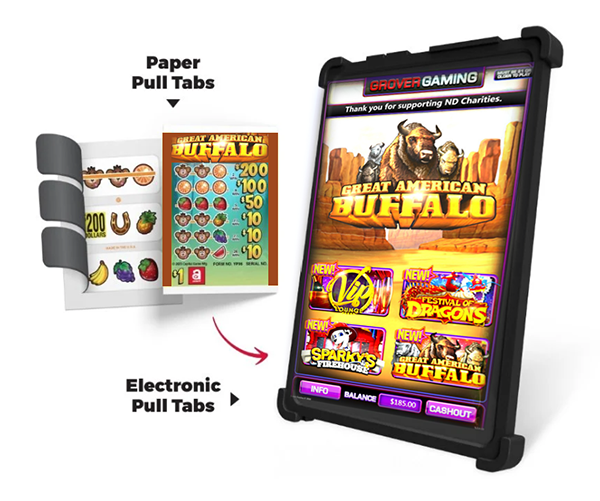 Electronic pull tabs—often called e-tabs—are a modern version of the paper pull tabs that Maine nonprofits and veterans organizations have used for decades to raise funds for their missions. Like traditional pull tabs, e-tabs are designed to be simple, transparent, and fair, with clearly defined odds and predetermined prizes. The only difference is the format: instead of peeling back paper, players reveal the outcome on an approved electronic device.
While e-tabs may be played on a tablet or touchscreen cabinet, they are fundamentally different from casino slot machines. Slot machines rely on random number generators that produce endless, independent outcomes. E-tabs do not. Each e-tab game is based on a finite pool of digital tickets—just like a box of paper pull tabs—with a set number of winners and a defined payout. Once those tickets are played, the game ends. There are no infinite spins, changing odds, or hidden mechanics.
E-tabs are also regulated and used very differently than casino gambling. They are limited to qualified nonprofit settings, subject to strict oversight, and designed specifically for charitable fundraising—not commercial profit. For Maine’s nonprofits and veterans organizations, e-tabs offer a responsible, modern tool to support local programs, keep resources in the community, and continue a long-standing tradition of charitable gaming in a way that fits today’s world.
E-Tabs Are Digital Pull Tabs — Not Slots
The most important difference comes down to how outcomes are determined.
Slot machines use a random number generator (RNG). Every spin is independent, with unlimited possible outcomes, and the odds never change based on what’s already been played.
E-tabs do not work that way. Instead, they operate on a finite, predetermined pool of tickets, just like traditional paper pull tabs. Each game has:
-
A set number of tickets
-
A known number of winners
-
Fixed prize amounts
-
Clearly defined odds
Once all the winning tickets in that digital “deck” are claimed, the game ends and must be reset. There are no infinite spins and no constantly recalculated odds.
Limited, Controlled, and Purpose-Built for Charity
E-tabs are designed to be limited in scope and access, unlike commercial slot machines found in casinos.
Key differences include:
-
Limited access:
E-tabs are typically restricted to members of a qualified nonprofit organization and their guests—not the general public. -
Limited game content:
E-tabs do not offer spinning reels, video poker, blackjack, keno, bingo, or other casino-style games. They are designed to replicate the simple experience of revealing a pull tab. -
Limited number of machines:
Nonprofits are capped at a small number of e-tab devices, based on membership size—nothing like casino floors with thousands of machines. -
Limited locations:
E-tabs are only allowed in qualified nonprofit or charitable settings, such as veterans halls or fraternal organizations—not bars, taverns, or commercial gambling venues. -
Limited bets and prizes:
E-tabs have set bet limits and capped top prizes, unlike slot machines that can allow very large wagers or multi-million-dollar jackpots.
A Different Purpose Entirely
Perhaps most importantly, e-tabs exist for a different reason.
Slot machines are commercial, for-profit gaming devices designed to maximize revenue for casinos.
E-tabs are a charitable fundraising tool. By law, proceeds are directed back to nonprofit organizations—supporting veterans services, community programs, and local causes right here in Maine.
Why This Distinction Matters
E-tabs modernize a fundraising model that Mainers already know and trust, without turning nonprofit spaces into casinos or expanding commercial gambling. They preserve the structure, transparency, and safeguards of traditional pull tabs—while offering a more efficient, up-to-date way for nonprofits to raise funds.
In short: e-tabs are not slot machines.
They are a controlled, regulated, charitable gaming tool designed to support Maine communities—not profit off them.